Over the past four years, the Hubs4Circularity Community of Practice has established a network of over 1,750 practitioners, supported by a dedicated Knowledge Platform and practical tools helping regions and industries accelerate the circular transition. The initiative now enters a new phase.
Since 2022, the two consortia of the Horizon Europe projects H4C Europe and H4C ECoP have jointly built a European Community of Practice dedicated to exchanging knowledge and best practices, as well as developing and defining business models. The goal has been to support regions, cities, industry, and research by enhancing the connection of material, energy, water, waste, and data flows, facilitating building, ecosystems of industrial and industrial-urban symbiosis, and circular economy.
Europe faces increasing pressure to deliver climate neutrality, reduce dependency on imported raw materials and build resilient value chains. Hubs4Circularity (H4C) foster collaboration between industry, regional administrations, research organisations and universities, and other stakeholders to realize small and large projects that reduce emissions, extract and utilize valuable materials from waste streams and improve energy efficiency.
Practical tools for industry and regions
A central achievement of the H4C Community of Practice is the H4C Knowledge Platform, a digital exchange hub consolidating experiences, tools, and learning resources. The platform is designed to support Hubs4Circularity initiatives and will continue to operate beyond the lifetime of the two projects as a European reference point.
To support the implementation of measures to improve sustainability and circularity on the ground, the H4C Community of Practice has developed a wide range of useful resources for industrial stakeholders, regional authorities and innovation actors, including:
- Sector guides for steel, cement, ceramics, pulp and paper, minerals and non-ferrous metals, highlighting opportunities such as waste heat recovery and by-product valorisation;
- A guide to stakeholder engagement, providing structured approaches to aligning industry, regulators, investors and local actors;
- A guide to the societal impacts of industrial-urban symbiosis, highlighting environmental, economic and social benefits for local communities.
Contributing to policy and standardisation
The Hubs4Circularity Community of Practice has also contributed to shaping the broader European circular economy agenda. Key outputs include:
- A white paper with the Processes4Planet partnership that outlines strategic recommendations for funding, policy frameworks and operational support;
- Inputs to an industrial symbiosis standardisation roadmap, helping to create a common framework for future development and scaling.
The H4C Community of Practice has gathered and documented real-world case studies from across Europe that illustrate how industrial and industrial-urban symbiosis can deliver tangible results in different regional contexts. Examples include:
- Industrial collaboration models in regions such as Navarra (Spain), where companies increasingly view symbiosis facilitators as partners in innovation rather than regulators;
- Regional ecosystem development in Päijät-Häme (Finland), combining industrial symbiosis with carbon capture strategies to transform industrial heritage;
- Community-level engagement initiatives in Roubaix (France), demonstrating the social dimension of circular economy transitions;
- Emerging symbiosis approaches in Norway’s Møre and Romsdal region, highlighting the role of governance and regional collaboration;
- Asturias AsPH4C (Spain) with the “Reclaimed Water for Industry” project, whose target is to supply regenerated wastewater to the main industrial areas of Gijón, Avilés, and Oviedo;
- Smart Delta Resources (The Netherlands/Belgium) with the world’s first cross-border carbon capture and storage project of this type where CO₂ will be captured and liquefied at Yara Sluiskil, transported by ship to Norway, and permanently stored by the Northern Lights;
- At the industrial park GreenLab (Denmark) research projects have been initiated on areas such as optimisation of integrated energy systems, modelling of Power-to-X operations, digitalisation of industrial heat systems, and analysis of interactions between energy, carbon and water systems;
- Nordland Hub (Norway) as an example of local application with the use of industrial waste heat for smolt production, linking process industries with aquaculture in locations such as Mo Industrial Park and Glomfjord Industripark.
A community that continues beyond the projects
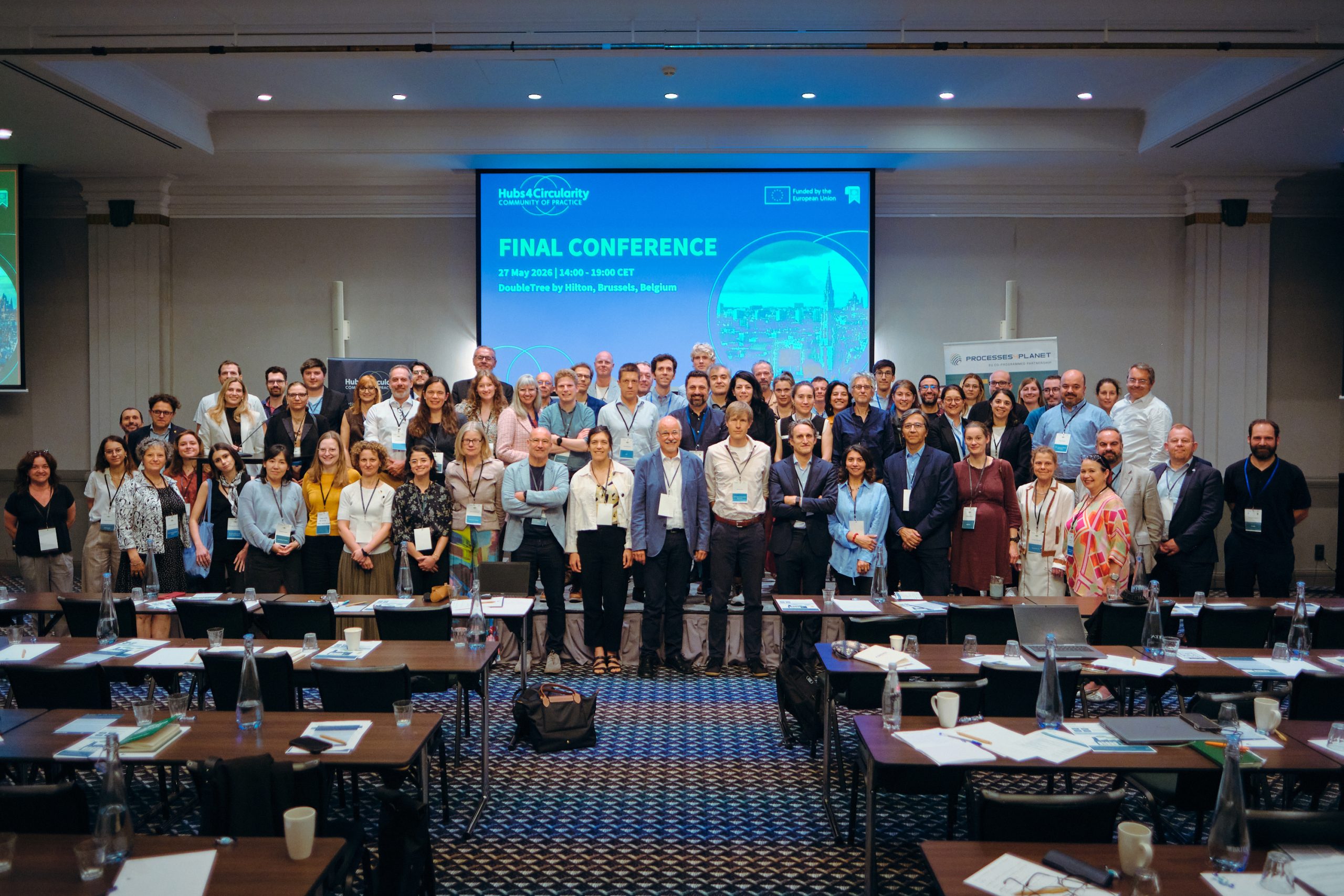
The projects H4C Europe and H4C ECoP concluded with the Final Conference of the Hubs4Circularity Community of Practice on 27 May 2026 in Brussels. Approximately 150 representatives from industry, policymaking, research, regions, and cities gathered to discuss the project results, share experiences from European Hubs4Circularity, and explore opportunities to sustain the H4C Community of Practice long-term.
The conference programme highlighted key findings from the Hubs4Circularity Community of Practice, strategic perspectives, and it featured two thematic sessions: one on industrial hubs driving defossilisation and circular economy projects in industrial clusters and one on regional hubs that foster circular ecosystems on a broad scale.
While the two projects H4C Europe and H4C ECoP will be concluded by 31 May 2026, the H4C Knowledge Platform and knowledge exchange activities will be continued in the frame of the Horizon Europe project UNITED CIRCLES. The consortia also hope that long-term support from the European Commission will continue for these networking and knowledge-sharing activities, given their importance for scaling industrial and industrial-urban symbiosis initiatives across Europe.
Further information: www.h4c-community.eu
H4C Europe is funded under grant agreement N° 101058416.
H4C ECoP is funded under grant agreement N° 101058656.
Photo: Participants of the Hubs4Circularity Community of Practice Final Conference on 27 May 2026 in Brussels, Belgium (©DECHEMA / Photo by Sam Glazier)