As industries and regions across Europe work towards climate neutrality, resource resilience, and circular economy objectives, industrial-urban symbiosis (I-US) is becoming an increasingly important approach to transforming industrial ecosystems.
To support this transition, the Hubs4Circularity Community of Practice has launched a new collection of practical guides exploring how industrial symbiosis can be applied across territories and industrial sectors.
Together, the guides provide practical entry points for public authorities, industrial stakeholders, facilitators, and innovation actors seeking to develop more circular and collaborative industrial ecosystems.
Industrial-urban symbiosis presents a systems approach to improving resource efficiency by enabling one organisation to use under-utilised resources from another. Across Europe, industrial symbiosis is increasingly helping industries reduce emissions, valorise by-products, improve resource efficiency, and strengthen local value chains.
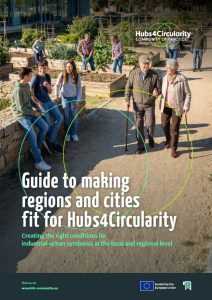
Guide to making regions and cities fit for Hubs4Circularity
The Guide to Making Regions and Cities Fit for Hubs4Circularity focuses on the role of local and regional authorities in enabling industrial-urban symbiosis ecosystems.
The guide explores:
- Governance and policy approaches supporting industrial symbiosis
- Financing and facilitation mechanisms
- Common barriers and enabling conditions
- Systems thinking and long-term strategic planning
- Practical examples and recommendations from regions across Europe
Featuring insights from territories including Friesland, Navarra, Roubaix, Møre og Romsdal, and others, the guide highlights how cities and regions can create the right conditions for circular industrial transformation.
Who should read this guide?
Municipalities, regional authorities, industrial park operators, circular economy practitioners, policy officers, and regional development agencies working on industrial transition and climate neutrality.
—-
Sector fitness guides
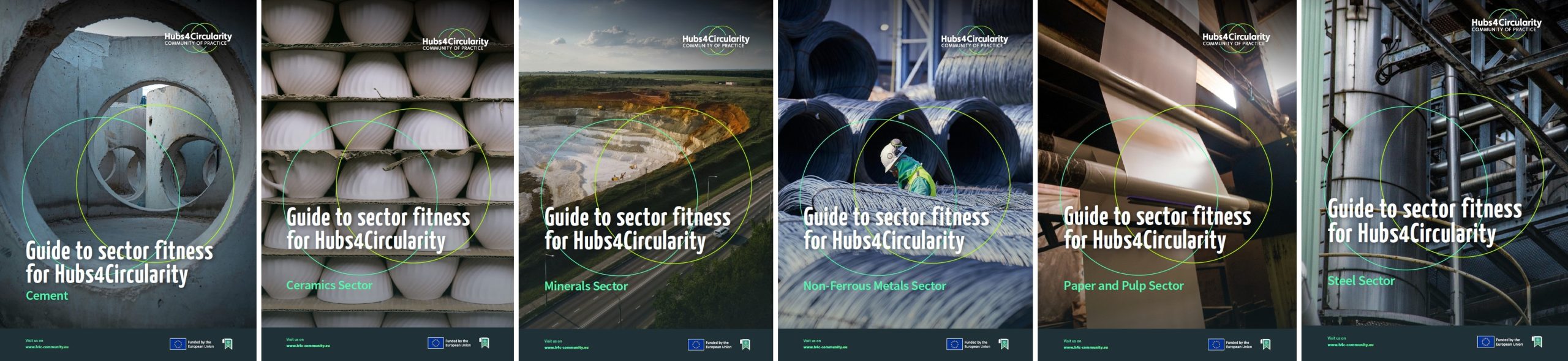
The new sector fitness guide series explores how industrial symbiosis can support resource efficiency, emissions reduction, and circularity across key industrial sectors. Each guide introduces the sector context, outlines industrial symbiosis opportunities, and highlights examples of material, energy, water, and by-product exchanges already being implemented in practice.
- Cement sector: The cement guide explores how industrial symbiosis can support lower emissions, alternative fuels and raw materials, co-processing approaches, and more resilient supply chains in one of Europe’s most emissions-intensive sectors.
- Ceramics sector: The ceramics guide highlights opportunities including waste heat recovery, wastewater sludge substitution, and diverting ceramic waste from landfill into productive use in construction applications.
- Minerals sector: The minerals guide focuses on valorisation of by-products, circular input integration, and industrial collaboration to reduce operational costs and environmental impacts.
- Non-ferrous metals sector: The non-ferrous metals guide explores opportunities ranging from metal recovery from waste streams to industrial reuse of residues and symbiotic exchanges supporting critical raw material resilience.
- Paper and pulp sector: The paper and pulp guide showcases how the sector acts as an “anchor industry” for industrial symbiosis through energy recovery, material reuse, water cascading, and chemical recovery processes.
- Steel sector: The steel guide outlines opportunities including scrap recycling, fuel substitution, energy recovery, and resource exchanges with other industrial sectors.
Who should read the sector guides?
Industrial stakeholders, trade associations, industrial park managers, policy makers, sustainability professionals, circular economy practitioners, and innovation actors working across Europe’s industrial ecosystems.
All the guides are available via the H4C Knowledge Platform.