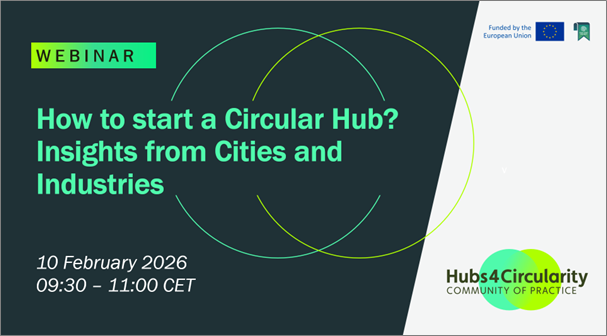
The webinar “How to start a Circular Hub? Insights from Cities and Industries” on 10 February 2026, organised by the Hubs4Circularity Community of Practice and the EU project REDOL, gave insights to pathways, experiences, motivations and bottlenecks during the implementation of Industrial–Urban Symbiosis (I-US) solutions.
The recording of the webinar is available on YouTube.
The webinar featured contributions from three cities, each with different starting points and circularity ambitions:
• Bornholm (Denmark) shared its Vision 2032 strategy to eliminate incineration and landfill, positioning the island as a real-life laboratory for circular transition, driven by stakeholder engagement and material flow mapping.
• Prato (Italy) presented its textile-focused circular hub model, built on strong district governance and proactive alignment with upcoming EU regulations (Ecodesign, EPR, Digital Product Passport). The Prato Textile Hub is expected to open in June 2026.
• Amsterdam (The Netherlands) showcased its ambitious circular targets (50% reduction of primary resource use by 2030 and full circularity by 2050), with a strong focus on construction and demolition waste, which represents around 70% of municipal waste.
To complement the municipal viewpoints, a major cement industry (CEMEX) highlighted the role of industrial symbiosis in substituting virgin raw materials and fossil fuels, presenting technical validation of alternative raw materials (up to 10% substitution without compromising quality) and discussing key regulatory and market barriers.
An introduction to the Hubs4Circularity Community of Practice, that is supporting Hubs4Circularity to accelerate industrial symbiosis and industrial-urban symbiosis, showed opportunities for collaboration.